Showing posts with label Gwen Bristow and Bruce Manning. Show all posts

8/29/22

Two and Two Make Twenty-Two (1932) by Gwen Bristow and Bruce Manning

Several months ago, I returned to the detective fiction of an American husband-and-wife writing tandem, Gwen Bristow and Bruce Manning, who collaborated on four detective novels during the early 1930s of which The Invisible Host (1930) is the most famous – as some consider it to be an ancestor of Agatha Christie's And Then There Were None (1939). I read a Dutch translation of The Invisible Host in the 2000s and thought the book unworthy of being compared to the Queen of Crime's celebrated mystery novel. So, when Dean Street Press reissued their novels, I was astonished to see The Invisible Host garner glowing, multi-star reviews. The damn thing even defeated John Dickson Carr's Till Death Do Us Part (1944) to win the 2021 Reprint of the Year Award

I needed to understand what happened and how, but, before taking a second look at The Invisible Host, I wanted to read one or two of their other mysteries as they promised to be a somewhat more conventional. The Gutenberg Murders (1931) certainly is an improvement over The Invisible Host and intended to do The Mardi Grass Murders (1932) next, but after my previous read, The Seiren Island Murder Case, I wanted another one of those isolated, storm tossed island mysteries. Bristow and Manning happened to have penned such a mystery novels with comments and reviews promising an ending that can actually be compared to Christie. 

Two and Two Make Twenty-Two (1932) is Bristow and Manning's fourth and final mystery novel. A standalone novel that takes place on "one of the many dots that speckle the Gulf off the Louisiana-Mississippi coastline," Paradise Island, which had been turned into "a glittering resort" by the current owner, Brett Allison – who had bought the island for next to nothing. Allison cleared the "matted tangle" of jungles and swamps to make way for "stables, wharfs, cottages, a golf course, tennis courts, shooting ranges, gaming rooms and the hotel," the Peacock Club. So he became "one of the most famous hosts in America," but authorities have good reason to believe cocaine, heroine and opium are being smuggled into the mainland US from Paradise Island.

The US Federal Government appointed "an untouchable committee" to trace the source of the drugs, but, three years of investigation, only revealed "the lesser men in the organization" and never the leaders or the mysterious woman – who acted as the middleman between the top and bottom men of the gang. Every time they got close to the source, the trail abruptly ended. Until a new trail lead them to Paradise Island ("an ideal landing-place for contraband drugs") and a young woman, Miss Eva Shale. She has a lot money to burn without any visible source of income and is very reticence to talk about herself or her past. Something that was bound to draw the attention of the authorities.

So three Federal investigators, Major Jack Raymond, Andrew Dillingham and Linton Barclay, travel to Paradise Island as a tropical storm is about to sweep the island. Nearly everyone has gone to mainland to weather out the storm and with the island virtually deserted, it's "a pretty good time to make a search and an arrest." But complication soon arise. Firstly, Andrew Dillingham has fallen for Eva Shale and now has some qualms about trapping "a young girl into admitting that she was the mysterious woman of the government reports." Secondly, Linton Barclay is stabbed to death at his cottage around the time the storm arrives. A storm cutting a dozen people off from the mainland who now have to secure the crime scene and try to find the murderer.

When you read the first half dozen chapters, until the murder is discovered, you get the idea Two and Two Make Twenty-Two is only posing as a traditional mystery, but in actuality a crime novel with a remarkable contemporary feeling to it. Those six chapters recalled Basil Thomson's The Milliner's Hat Mystery (1937) as these drug running plot-threads usually hover discreetly in the background of 1930s detective novels. But when the murder is discovered, the story goes a decade back in time as it shifted from drug running to a 1920s style drawing room mystery with an island setting and crime scene resembling a busy thoroughfare. One of the characters even remarks, "that cottage would make a swell place for a cigar store" since "everybody goes by there." A remarkable feat considering Paradise Island was practically deserted at the time.

There were two prospective buyers of the island, "a fellow named Foster" and Tracy Cupping. Cupping has brought along his much younger wife, Imogen Cupping, who really tests her husband's "gentleman's dislike of messy publicity." Judith Garon is a guest who has stayed behind on the island, because she has been quite "resentful of Barclay's attentions to Eva." A number of employees of the Peacock Club like the club manager, chauffeur, telephone and radio operators, but the best character of all is a late arrival on the island, Mrs. Daisy Dillingham, who's Andrew's influential grandmother and does, and says, what she wants – like landing in a private plane on the golf course of the club. Mrs. Dillingham could have been developed into an interesting series-detective going by how she solved the murder and dealt with the murderer.

So there you have enough characters to pad out a good, old-fashioned whodunit and that brings us to the story's biggest strength and major weakness. The middle portion of Two and Two Make Twenty-Two is a paint-by-numbers, 1920s style, detective story with the characters tramping around the crime scene and have to be pried open to get their explanation. Everyone's movement is tracked to establish or breakdown alibis and two shady characters turn up to add a hint of the pulp thriller to what's already going on. And had it not been for the ending, Two and Two Make Twenty-Two would have nothing to make it standout. Not even with the prominent drug plot-thread and the wonderful character of Daisy Dillingham. But what an ending! What a twist!

When you're wading waist-deep in detective fiction, you get those jolts of genuine surprise less often and eventually become a bit rare. Two and Two Make Twenty-Two can join Joan Sanger's The Case of the Missing Corpse (1936) and Anne van Doorn's De man die zijn geweten ontlastte (The Man Who Relieved His Conscience, 2019) as detective novels that gave this fan, who has seen it all, the kind of jolt I remember from my first reading of Christie's Murder on the Orient Express (1934). If Bristow and Manning had dealt the reader a slightly fairer hand of clues and red herrings, I would have unhesitatingly placed the book among the top-tier Golden Age mysteries as better clueing and misdirection would have improved the middle portion considerably. Now it falls just short of the mark, but a wonderfully done, vintage mystery novel saving the best for last.

I'm going to return to Bristow and Manning before the end of the year, but I'm going to save The Mardi Grass Murders for last and reread The Invisible Host next. I really, really need to understand how it could have beaten Carr's Till Death Do Us Part. My negative opinion better be due to a shoddy translation or else I'm going to angrily shake a gibbet cage again.

5/9/22

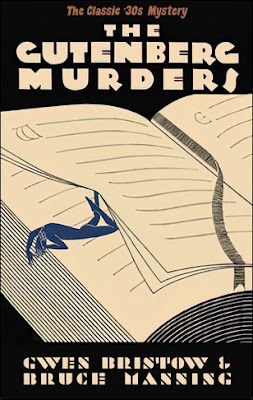
The Gutenberg Murders (1931) by Gwen Bristow and Bruce Manning

Gwen Bristow and Bruce Manning were an American husband-and-wife writing team who got their start "as Roaring Twenties newspaper reporters" working "the mean moonlight and magnolia streets" of New Orleans, Louisiana, covering everything from the Great Mississippi River Flood to "bizarre and grisly killings" – providing them with first-hand experience for their detective novels. During the early 1930s, Bristow and Manning collaborated on four novels with the least obscure one being their first, The Invisible Host (1930). 

The Invisible Host is a pulp-style thriller and the only reason why it wasn't completely forgotten is that some people have heralded it as the inspiration of Agatha Christie's And Then There Were None (1939). I read a Dutch translation back in 2000s and dismissed it at the time as an awful piece of crime fiction, but, when Dean Street Press reprinted their novels last year, jubilant reviews of The Invisible Host began to pour in. More astonishingly, The Invisible Host defeated John Dickson Carr's Till Death Do Us Part (1944) with a 16 vote lead to win the 2021 Reprint of the Year Award. So did someone stuff the ballot box or did I miss something on my first read? Maybe the problem was the translation.

Either way, the positive reactions reintroduced Bristow, Manning and The Invisible Host to my to-be-read pile to see what all the excitement is about, but decided to begin with their more formal, traditionally-styled detective novels – which happen to be part of a two-book series. The Gutenberg Murders (1931) and The Mardi Gras Murders (1932) share a small cast of characters, "both major and minor," who play the role of detectives and associates. I really was torn between the two as the introduction, written by Curt Evans, promised "a locked room killing on a parade float" in The Mardi Gras Murder. This time, I didn't want to be that predictable, chronologically challenged and obsessed locked room fanboy. So I settled on The Gutenberg Murders. Yes, it was a vast improvement on their maiden effort. 

The Gutenberg Murders introduces the district attorney of Orleans Parish, Dan Farrell, who's not a brilliant man, but he has "a good deal of respect for the sort of learning which he regarded as a mental luxury." So he's not above consulting the ace crime reporter of The Morning Creole, Wade (no first name given). They're respectively assisted by Captain Dennis Murphy of the New Orleans Homicide Squad and the Creole's impish star photographer, Wiggins.

Dan Farrell is completely puzzled by the Quentin Ulman case. Quentin Ulman, assistant librarian of the Sheldon Memorial Library, is "an unusual man" suspected of "an unusual crime" and is suspected of "robbing the library for the past six months" of its valuable treasures. The latest theft was of nine recently acquired, highly prized leaves from the Gutenberg Bible, which were the pride and joy of the head librarian, Dr. Julian Prentiss. So he brought the case to the district attorney, but he doesn't want Ulman arrested. Just the return of the stolen books and his precious Bible fragments, but complicating an apparently simple case of theft is that the library is caked in dirt.

The head trustee of the library and Dr. Prentiss' longtime rival, Professor Alfredo Gonzales, whose twenty year long squabble with the head librarian came to a head when he voiced his suspicion the Gutenberg fragment was not genuine – indirectly accusing Prentiss having been fooled into buying a forgery. But there's also talk of Gonzales charming, much younger and "not very discreet" wife, Winifred, has gotten herself involved with Ulman. This is practically public knowledge and there are "whispers that Ulman sold the damn thing to buy pearls for Mrs. Gonzales," which stung her husband "where it hurts a Cuban gentleman worst." And there are the other people who hang around the library who either hold something back or simply cause trouble. Terry Sheldon is a sculptor and nephew of the library's founder, but the impulsive sort with a short temper. Luke Dancy is the personal secretary of Dr. Prentiss and "one of the regular American-Anglomaniac school" who dressed English and speaks with London-borrowed phrases. Marie Castille is a medical student who works at the library during the summer months and a distant cousin of Professor Gonzales. All of them hold something back or have something hide.

So more than enough material to complicate a simply, straightforward case of theft and fill a front page, or two, but, before the investigation can even begin, Ulman is murdered. Ulman's "charred and smoking skeleton" is found on a dirt road near the bindery. And thus began the Bible Murder Case.

Dan Farrell takes the unusual decision to deputize Wade and gave him a "tin badge" to act like a French juge d'instruction (examining magistrate). Wade gets a free hand to act as he sees fits from questioning suspects, as he tries to pry loose their jealously guarded secrets, to handling evidence, testing alibis and rooting around for motives – even threatening to arrest people or place them under police protection. One chapter details a gross invasion of privacy when Wiggins and his noiseless camera invade a home to secretly eavesdrop on a private conversation, which is of course used. So a little improbably, but sort of works with New Orleans as a backdrop. Since everyone insists on holding back important, even dangerous information, the torch murders continues with the third murder being a quasi-impossible crime. Every suspect has "a cast-iron alibi furnished by members of the police department."

Gwen Bristow and Bruce Manning came up with a fascinating solution to the torch murders that should have been used to turn the story into a full-blown impossible crime novel. Fittingly, Wade pieces together the murder method after reading Euripides and Eusebe Salverte's The Philosophy of Magic, Prodigies and Apparent Miracles (1829). Only acceptable place to the find answers in a bibliophile mystery. However, Bristow and Manning also plotted the story along a straight, narrow line that glossed over a few details and didn't ask some very obvious question.

For example, the medical and forensic examinations of the victims (i.e. how they were set ablaze) was deliberately kept vague, because a thorough examination would have solved too much too soon. In the hands of the Radfords, The Gutenberg Murders would probably have been a short story instead of a novel-length mystery. Secondly, it's established with Quentin Ulman's death that the murderer hadn't burned the body to conceal his identity. Ulman was identified by items found on the body and it was suggested the murderer wanted to make him "a hideous memory," but nobody thought of the possibility that Ulman could have staged his own death. After all, Ulman was suspected of having stolen a small fortune in antiquarian treasures. So why not try to shake everyone off his back once he realized the game was over and start over somewhere else under a new name and nice little nest egg. A possibility destroyed by the second and third murder, but it takes a while to get to them and it's just weird nobody considered the possibility until the other murders happened.

Nitpicking aside, The Gutenberg Murders is a massive improvement over what I remember of The Invisible Host. A well-written, competently plotted detective novel with an unusual piece of detective work that nonetheless logically tied together the who, why and how. A solution both logical and not wholly unsatisfying, but lacked a bit of a punch. So not a first-rate specimen of the vintage detective novel, but another good and solid second-stringer that comes particularly recommended to fans of biblio mysteries. More importantly, The Gutenberg Murders has convinced me to move The Mardi Gras Murders and Two and Two Make Twenty-Two (1932) up a few places on the big pile. Redemption might be imminent!

And on a final note, I have come across a lot of good, but second-string, mysteries lately and will try to pick a title from the top-tier next time.